Fun Facts - Christmas Traditions
Boxing Day
Trafalgar Square Christmas Tree
Trafalgar Square Christmas Tree
Ah, Boxing Day, that quaint national holiday in the U.K. that follows the day after Christmas Day. Who would have thought to celebrate the sport of boxing or the boxes our Christmas presents come in? Well, the people of the U.K. have been celebrating this since 1871, well into Queen Victoria’s reign. One of my American friends said this holiday fits the quirky nature of the people of the U.K. However, over time several interpretations of its origin have evolved, so let us analyze them.
One of the possibilities is that alms boxes for the poor were left out on St. Stephen’s Day, which is the day after Christmas. What are alms boxes, you ask? They are boxes left in churches that are filled by parishioners with food, clothing, and money for the poor.
Another possibility surrounds servants of the wealthy and the aristocracy being rewarded for their day of work on Christmas Day. They were given the next day off to celebrate Christmas at their home. They were given boxes containing little gifts, perhaps bonuses and leftover food from the Christmas Day festivities of their employers.
Of course, most of the working population in the U.K. did not work on the large estates of the landed gentry so they had a different way of celebrating this public holiday, also known as a bank holiday. Sporting events could have been one of the ways they would celebrate the day off, as many kinds of sports are played in Great Britain on this day.
Growing up in my home in Nottingham the day was spent going to a football match, or watching horse racing, and then going home and eating leftover food from our Christmas meal.
So, when December 26th comes around this year think of things you might do, realizing that in the U.S. you do not get a paid day off to enjoy it!
By Pam S.
Images: courtesy of Pinterest.com
Trafalgar Square Christmas Tree
Trafalgar Square Christmas Tree
Trafalgar Square Christmas Tree
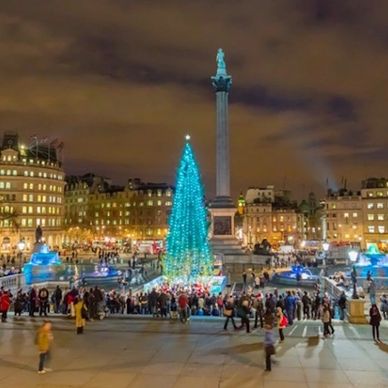
A symbol of peace and friendship
To quote the Lord Mayor of Westminster at the 2019 lighting of the tree, “In a time of turmoil and uncertainty, to have this tradition continuing for decades is a very important sign of stability, of friendship between nations, of dialogue and real commitment to understanding other people.”
These words continue to resonate.
In 1947, as a show of appreciation for Britain’s support throughout World War II, the Norwegians sent a Norwegian Spruce, grown in the Ostmarka forest east of Oslo. This gift to the British people, has been an annual event ever since.
At least 10 years ahead, a tree is chosen and given special treatment. It is known as the “Queen of the Forest.” In November of each year the chosen tree, which is usually around 80 feet tall, is cut down and ceremoniously handed over to the people of London. It then travels by boat and truck to be erected by hydraulic crane.
At the base of the tree stands a plaque, bearing the words: This tree is given by the city of Oslo as a token of Norwegian gratitude to the people of London for their assistance during the years 1940-45.
The tree lighting ceremony is the first Thursday night in December and the tree stays in place until Twelfth Night.
By Susanne Y.
Image: courtesy of @trafalgartree
Christmas in South Africa
Trafalgar Square Christmas Tree
Christmas in South Africa
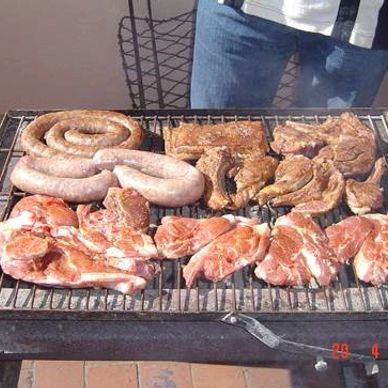
When the majority of us ex-pats think of Christmas, we think of cozy cottages, with frost or snow on the windows, a roaring fire with a decorated tree inside and a mug of something hot and delicious, with a mince pie or two - just warm and inviting. But for a lot of us, Christmas memories are of a long hot summer day at the beach and cooking outside.
Many South Africans celebrate Christmas with a Braai (pronounced “bry”). It is an Afrikaans word meaning to grill over an open fire.
A braai is a social occasion that has specific traditions. In most South African cultures, women rarely braai (cook) meat at a social gathering. The men braai the meat and the women prepare the side dishes and the desserts. The meal is subsequently eaten outside by the fire/braai. Meats are the star of the South African braai. They typically include: sosaties, a type of kebab made from marinated chicken, pork, and lamb; lamb chops and steaks; and sausages of different flavors and thickness known as boerewors.
Side dishes include the braaibroodjie a cheese-tomato-onion grilled sandwich. This is normally served hot off the grill and devoured before the meal. Mieliepap or phutu is a porridge dish made from course corn meal boiled in hot water with butter and salt, often served with a sweetish, relish-like sauce called chakalaka made with tomato and onion, with bacon, cheese and corn kernels added.
Sweet desserts are a must after this meal and include the malva pudding with its gooey center and drenched in vanilla custard. A melktert is Afrikaans for milk tart and is a dessert with a sweet pastry crust and a custard filling topped with cinnamon. Another favorite is the fried doughnut-like twisted Afrikaner-Cape Malay pastry called kooksister.
It is traditional to sit around the braai long after the food has been cooked (and eaten) to relax and enjoy the company of family or friends and probably an ice-cold beer too. There may not be a stuffed turkey or Christmas pudding, but you will still find Christmas trees, decorations, and Father Christmas (Santa) will still visit!
Braais are not limited to Christmas of course. The braai can be found at most social events and gatherings in South Africa, Namibia, Zimbabwe and Zambia.
Lee V.